

 Language
 Language

Wire harnesses would not be so widely used if they didn't present substantial benefits for wiring applications. Among other advantages, wiring harnesses benefit companies in the following ways:
Decreases cost compared to multiple individual assemblies Improves organization, especially when a system relies on hundreds of feet of complicated wiring.
Decreases installation time for projects involving extensive networks of wiring or cabling.
Protects conductors from the elements outdoors or from chemical and moisture exposure indoors.
Provides a safer work environment by cleaning up loose or scattered wires, maximizing space, and preventing trips and damage to wires and cable.
Enhances safety by minimizing the risk of shorts or electrical fires.
Decreases installation and maintenance time by potentially minimizing the number of connections and organizing components in a logical configuration.
The many benefits of wire harnesses stem from very simple design principles. Sheathes protect wires against abrasion or exposure to hazards, minimizing the risk of workplace incidents. Connectors, clips, lacing, and other organizational strategies drastically reduce the amount of space that wiring must occupy and ensure that technicians can easily locate the components that they need. For equipment or vehicles that regularly contend with a web of lengthy wires, a wire harness is sure to benefit everyone.
How is a Wiring Harness Created?
The electronic contents inside an automobile are increasing day by day and posing newer challenges in terms of managing the wiring harnesses that connect them.
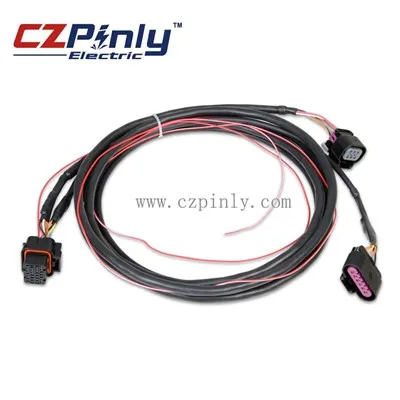
A wire harness is a specially designed system that keeps numerous wires or cables organized. It is a systematic and integrated arrangement of cables within an insulating material.
The purpose of the wiring assembly is to transmit a signal or electrical power. Cables are bound together with straps, cable ties, cable lacing, sleeves, electrical tape, conduit, or a combination thereof.
Rather than manually routing and connecting individual strands, the wires are cut to length, bundled, and clamped to the terminal or connector housing to form a single piece.
The wiring harness is created in two stages. It is designed in a software tool first and then the 2D and 3D layout is shared with manufacturing plants to build the harness.
The specific process of vehicle wiring harness design involves the following steps:
First, the electrical system engineer provides the functions of the entire electrical system, including the electrical load and related unique requirements. The state of the electrical equipment, the installation location, and the form of connection between the wiring harness and the electrical equipment are all key considerations.
From the electrical functions and requirements provided by the electrical system engineer, the complete vehicle electrical schematic is created by adding components required for a function and connecting them together. The functions which are commonly used across multiple vehicles in an architecture platform are stored together.
After the schematic is defined, the wiring harness design is created. In one platform, the end customers can have a variety of requirements. It is very time-consuming and expensive if different designs are created for each end user's requirements separately. So, the designer takes care of the multiple variants while designing the wiring harness.
At the end, a 2D representation of all the wiring designs is created to show the way different wires are bundled and how the bundles are covered to secure the wires. End connectors are also shown in this 2D diagram.
These designs can interact with 3D tools for the import and export of details. The wire lengths can be imported from the 3D tool and the end-to-end connection details are exported from the wiring harness tool to a 3D tool. The 3D tool uses these data to add passive components such as straps, cable ties, cable lacing, sleeves, electrical tape, and conduits in relevant locations and send them back to the wiring harness tool.
After the design is completed in software, the wire harness is manufactured in the manufacturing plant starting from the cutting area then the pre-assembly area, and finally in the assembly area.
Wiring harnesses solve many challenges associated with electrical systems. By combining many individual wiring elements, they make it easier to connect and assemble complex systems. At the same time, they provide additional protection to wires and cables, preventing unwanted flexion and insulating bundles against the environment.
This combination of benefits means that wiring harnesses and cable assemblies are used across diverse applications. Most manufacturers find that combining electrical elements in a harness is a cost-effective way to improve performance while also simplifying installation. Uses can be found in industries ranging from aerospace to residential wiring.


Aerospace
Aerospace equipment often includes dense bundles of electrical and communication cables. Wire harnesses enable power transmission in aircraft engines, data transmission from satellites, and similar aerospace applications.
Automotive
The automotive industry makes extensive use of wiring harnesses and cable assemblies, including in both gasoline and electrical vehicles. In these contexts, harnesses are indispensable for saving space and ensuring wires fit around mechanical components. Organizing conductors is also essential for keeping distinct systems separate under the hood, enabling both efficient operation and easy maintenance. Automotive systems using harnesses include lights, turn signals, displays, and more.
Medical
In the hospital, clinicians must be able to quickly establish reliable connections. In many cases, this is a matter of life and death, such as when setting up critical care equipment. Harnesses enable these rapid links, keeping patients safe. Other medical applications include more permanent installations such as imaging equipment and dental chairs.
Telecommunications
Telecommunications systems may include anywhere from tens to thousands of cables, all of which must be organized to save space and facilitate identification. Assemblies serve this role, bundling cables for modems, routers, and similar communication equipment.
Information Technology
Within IT, harnesses are used at every scale. Wire harnesses and cable assemblies save space within small laptops and organize the thousands of cables within a networking facility.
Cable assemblies and wire harnesses are often confused for being the same thing.
The confusion is understandable since many professionals use the terms interchangeably and the products themselves have very similar basic functions. Yet these products are very different from each other, as is their purpose, which means definitions need to be made in order to help people get the products they need. This is a brief explanation of cable assembly vs. wire harness, and how each product is used out in the world.
Before getting into the fighting differences of a cable assembly vs. wire harness, it's important to note the difference between wire and cable, since these terms are also used interchangeably despite being very different products. Essentially, a wire is a strand of material that conducts electricity, such as aluminum or copper. A cable, by contrast, is two or more wires that run together. They're often bonded or braided together, which is why you see cables that look like bunches of intertwined wires.
At their most basic, wire harneWire harnesssses are a simple exterior sheath that covers some wires or cables. It's usually made of thermoplastic or thermoset material which helps protect the wires from their environment. For the most part, wire harnesses bundle up cables and wires that are already protected by their own exterior sheaths. That means you could open up a wire harness and see multiple cables with their own coverings, but they're all in a single wire harness.
Wire harnesses are a low-cost electrical solution that's best for keeping electrical systems organized. By bundling wires and cables together, engineers and electrical contractors can keep their wiring systems organized. Since wire harnesses are often a low cost organizational tool, they aren't generally able to protect the wires inside from constant friction, temperature swings, or other factors that could cause damage to the wires inside the harness.
Cable assemblies are a group of wires or cables covered by a much more intensive exterior product. In general, they are made from heavy-duty materials, including shrink-wrapped thermoplastic, thermoplastic rubber, or vinyl. These assemblies serve a similar function to wire harnesses, including keeping wires and cables organized, but are designed for entirely different environments.
Cable assemblies are designed for specific environmental factors, including the size of the area where it's being used and the types of environmental factors it's likely to encounter. For this reason, cable assemblies can come in many different shapes and sizes, and are built to shield the interior wires and cables from heat, friction, moisture, abrasion, compression, and other hazards.
So what's the difference between wire harnesses and cable assemblies? Well, each is used in different environments. Wire harnesses offer a low-cost solution for keeping wires organized, while cable assemblies keep all of the products safe in the most extreme circumstances.
While designing your custom automotive wiring harness may not be complicated, it's time-consuming.
In addition, it requires electrical know-how and adherence to the electrical codes and guidelines. With that said, let's discuss the steps you can use to design yours:
Gather the components
Before considering the design, you must have the necessary components depending on your requirements.
Some of the components you need are connectors, wires, terminals, and heat shrink tubings.
You want to ensure the best quality possible for safety, reliability, and longevity for these components.
For instance, the right gauge wires, connectors, and insulation can withstand heat and extreme conditions.
Plan the harness
After you have all the material ready, you will need the design to follow. You must plan, measure, and draw to scale the wire size.
Then, establish the route your wires will follow and plan where the terminals and connectors will be.
Design planning helps your wiring be organized, neat, and easy to install. It also ensures the installation of all components, ensuring proper, reliable, and secure connection.


Connectors and terminal installation
Trusting you have your wires and connectors ready, the next step is to install the terminals and the connectors.
You can easily do this by using a crimping tool to install terminals on your wire ends. Then, depending on the male or female connector on your device, install the connectors to these terminals.
I recommend checking properly to ensure you securely fit connectors on the wires to avoid coming off during operation.
Testing your harness
Now that your harness is ready, the only remaining step is to ensure it works before you can install it.
You will need a multimeter gauge to test each wire for continuity and current flow. Check to ensure that you have not broken any connector and that all components are in place before installation.
Wiring harnesses come in all shapes and sizes, and they can become quite complex both mechanically and electrically. While there is a bit of design and assembly effort to create a wire harness that will work in an enclosure, wiring harnesses are worth the effort. This is especially true when a product goes into assembly and you need to idiot-proof your cabling. So if you're wondering what kind of wiring harness you might use in your product, take a look at these options.
Point-to-Point Cable Bundles
The simplest type of wiring harness uses point-to-point cable bundles and packages them together into a single harness assembly. Cable bundles can be packed together using adhesives, tapes, sheathing, or mesh jackets. The cables used in these bundles could be off-the-shelf cables, custom cables, or a combination of these. Interconnect topology that usually arises from this is point-to-point because of the direct connections via these cables.
Bifurcated Cables
Cabling coming off of a connector can be bifurcated, where a single connector has wiring splitting off to two different destinations. This would be used to have a single receptacle on one PCB connecting to at least two other PCBs. This is a more sophisticated type of wiring harness that involves mixing and matching connectors and receptacles across different boards.
Flex Printed Circuit (FPC) Cable
Flex ribbons can also be used as wiring harnesses, which would allow a mix of edge connectors, surface mount connectors, and even through-hole connectors to interface with a group of PCBs. Flex connectors have an advantage and that they are very flat and so they may be useful in very low profile products. In some products, a wire bundle in a standard wiring harness simply won’t fit in the design, so a flex cable becomes a very attractive option.
Pinly is a professional Automotive Wiring Harnesse&Auto Connector manufacturer.We specialized in providing various Wiring Harnesses,Automotive Connectors,Electric Connectors,Terminals,Wire Seals,Fuse Boxes and other related products about Wiring Assembly Systems. In our field ,we assist our customers to design their Vehicle's Wiring System for OEM/ODM servises and precipitate customer's design philosophy can be practic application.Also,we experienced in producing,assembling our products according to the client's requirements strictly.

Q: What is a wiring harness used for?
Q: Where is the wiring harness located in a car?
Q: Where are wiring harnesses used?
Q: What is the difference between a cable harness and a wire harness?
Q: Can a car run without a wiring harness?
Q: Do I have to use a wiring harness?
Q: Why would a wiring harness need to be replaced?
Q: How many circuits do I need for a wiring harness?
Q: How long does it take to replace a wiring harness?
Q: How to test a car wiring harness?
Q: How complex is wire harness manufacturing?
Q: Why are wire harness & cable assembly often confused?
We're professional wiring harness manufacturers and suppliers in China, specialized in providing high quality custom service. We warmly welcome you to wholesale high-grade wiring harness at low price from our factory. Contact us for more details.
12 pin auto connector, 4 Pin Auto Connectors, 12 Pin Female Auto Electrical Connector(0/10)
